 |
|---|
|
Home comfort is a must for all Sighthounds, not only for their mental health, (they NEED their owner's love and nearness), but also because they lack the protective fat layer of "ordinary" dogs and therefore feel the cold much more. They must also always lie on something soft (preferably the best sofa, chair, or your bed!) Another fact about them is, that when you own a dog that can be several miles away in just a few seconds, you really need a good, mutual, loving and trusting "bond" between owner and dog - and what better way to achieve that than to have them live their lives right beside you? Sighthounds are exceedingly faithful and devoted. Sighthounds just love to be several! Bo Bengtson wrote in his first very popular book about Whippets: "They are like peanuts: Once you've tried one, you can't stop, you just have to have one more and one more..."! |
|
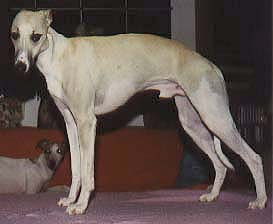
What I write here is generally speaking for (nearly) all Sighthounds Sighthounds are known for their speed and of course this shows itself in their their streamlined body form. (So don't buy a dog type who loves to run and race around for a while each day - if you cannot fulfill this need that they have!) |
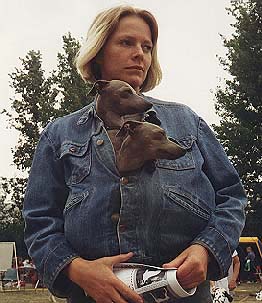 Photo above: A friend Tina with her two Danish bred "Italian girls" on a chilly day at a dog show! |
Sighthounds are generally some of the oldest known breeds. Most of them can trace their family tree right back to some of the first domesticated dogs. They were mainly developed to be fast running and to bring down the prey in full flight, kill cleanly and retrieve it or in some cases with larger prey, stay by it and hold it until the owners caught up. In this way they have always played a large and often vital role in obtaining extra food for their owners and in some countries, they still do! Only the very cleverest and fastest at the hunt would have been bred from and so they have slowly developed to what they are today over thousands of years. Their body form is not the result of any kind of artistic appreciation on the part of the breeders, they were chosen for breeding purely from their performance. How well they hunted and brought down the prey was all that was important. Different countries with varying climate, terrain and environment, plus different prey of all sizes and speeds and many other considerations, has resulted in a wide variety of breeds evolving in accordance to the local requirements. This is why they vary so much today, and you can see many different sizes and shapes, coat type and abilities. Some are lightening fast sprinters rather like the Cheetah, as for example Greyhounds and Whippets, and some are slower but can "run all day" if necessary, as for example Sloughis and Salukis. |
|
Some are used as watchdogs as well (the Azawakh in particular has a good degree of fierceness in it's nature and would protect its family to the death) and some breeds will even guard and herd the owner's domestic animals. Others, like the Italian Greyhound were used more for entertainment value and has been well loved by Royalty. Possibly also used to catch rats and mice in the palace/home! Some types are long haired, wire haired or smooth, some are big and some medium and small - there is a breed for every requirement! There are over 17 different breeds to choose from. Some are unfortunately now quite rare and you need to attend a dog show or travel abroad to see them.
|
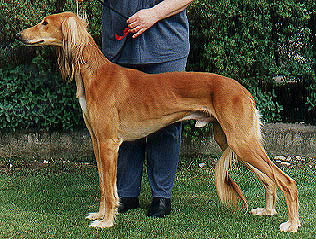 Saluki DKCH KLBCH KBHV95 Feisal's Qaaniy Qharim showing his pure streamlined elegance. |
In England, in the Middle Ages, what started as hunting out of necessity to get extra food for the family, developed to a fine sport for kings and other royal and rich persons! The excitement and thrill of the chase grew to a regular royal sport with set rules and regulations, many of which survive to this day. Nowadays, coursing and hunting after living prey is forbidden in the most of Europe, (including here in Denmark), but luckily for our dogs, lure coursing and track racing has been invented since the turn of the last century. |
 The Danish Kennel Club logo 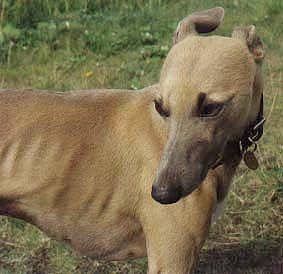 This is my Whippet Vibes Evening Silver "Smarty" at about two years. 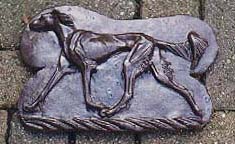 A Saluki relief showing the characteristic flying trot . 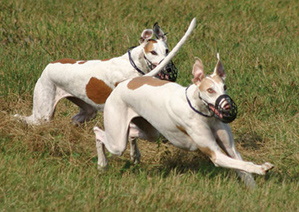 Two show greyhounds doing lure coursing in Denmark. 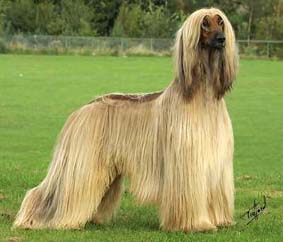 An Afghan hound showing off it's wonderful fur coat. 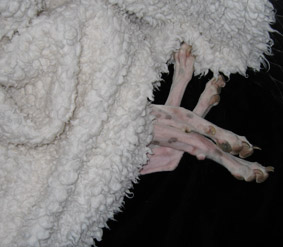 How Whippets like to sleep: Completely covered up! 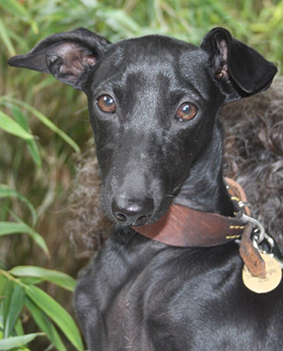 A young Italian Greyhound |
Since 1886, we in Denmark (where I now live), have also been able to show our dogs at various dog shows all over Europe. Denmark is a member of the FCI (Fédération Cynologique International) with DKK (the Danish Kennel Club) established in 1897, as the Danish representative organization or mother club for Denmark. Myndeklubben (The Danish Sighthound Club) is a special breed club under the DKK. Sighthounds still love it best when they are running around or chasing something. They like high levels of excitement for short periods of time. Sighthounds are surrounded by strange myths - at least they are in Denmark, where they are relatively unknown. For example, it is said that they have no brains! Particularly Afghan hounds have to live with this absolutely stupid notion. Nothing could be further from the truth! Maybe because their heads are relatively small in proportion to their bodies? But head size and form is just a refinement of their streamlined design for maximum speed. A large head would slow down a swift runner. But head size has no bearing on intelligence - otherwise all little dogs would be very stupid indeed! In fact Sighthounds are extremely intelligent, so intelligent that they think for themselves and that's why they don't ALWAYS do as we say! Some Sighthounds, (they vary greatly, even from within the same litter), can be very "wild and crazy" in their youth and a little too full of beans, often seriously trying the patience of the owner in the start. Some can also be very destructive in the home. Some can be hard to keep under control as their owners would wish. They also possess a very special charismatic charm. They are not like "ordinary" dogs, as only a sighthound owner understands, because it's hard to explain. They are just not hanging around getting in the way and under one's feet all day, demanding constant attention and needing a lot of discipline and training. (Apart from the Italian Greyhound!) Whippets and other Sighthounds just love to run, but not everyone lives near suitable wide open spaces - with preferably no wild animals around or trees and stones or busy roads where they could come to harm like dog parks and other enclosed areas - or beaches. They just love the chance to be a bit wild, which is after all, what they were once bred exclusively to do! |
| ONWARDS TO NEXT PAGE, all about Borzoi | or CLICK HERE TO GO BACK to Chooser My e-mail: janetfm@sighthound.net |
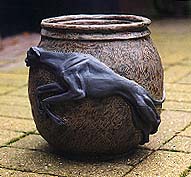
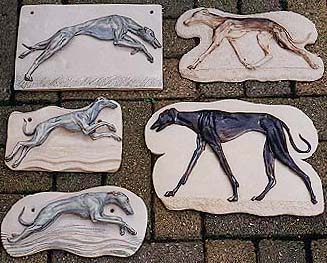 Some of my stoneware: From the top left: Greyhound, (which has become my logo - can be seen as the background of this page!) Whippet, Italian greyhound, Sloughi then a Whippet.